
🔎 Where did all the subjects go?
This guessing game series, Indovina un po' ("Guess a little"), is full of everyday Italian—but if you're new to the language, something may seem strange.
You'll hear lots of sentences that seem to have no subject at all.
💡News flash: in Italian, words like I, you, he, she, we, and they are often left out.
But don't worry—the subject hasn't disappeared. It's hiding inside the verb.
The ending of the verb tells Italians who is doing the action. It takes a little while to get used to, but these guessing game videos are excellent practice because you'll hear this pattern over and over again until it starts to sound natural.
Notice that in the following example, there is one word in Italian that represents two words in English!
È un animale molto grande. Cammina molto lentamente. Ha orecchie enormi ed è grigio. Ha una proboscide molto lunga e grossa e vive sempre in gruppo.
It is a very large animal. He walks very slowly. He has huge ears and is gray. He has a very long and thick trunk, and always lives in groups.
Captions 5-9, Indovina un po' EP 2
Play Caption
❓So how does this work?
Let's take the verb fare (to do, to make).
At first, we mention the person:
Roberto fa i compiti dopo scuola.
Roberto does his homework after school.
Now we want to keep talking about Roberto.
In English, we naturally switch from the name to a pronoun.
He does his homework right after school.
Italian can do that too.
Lui fa i compiti subito dopo scuola.
He does his homework right after school.
➡️ Notice: We included lui here to compare Italian with English. In everyday Italian, speakers often go straight from Roberto fa... to Fa..., without using the pronoun at all. In other words, once everyone knows we're talking about Roberto, Italian usually drops the pronoun.
Fa i compiti subito dopo scuola.
He does his homework right after school.
The verb ending -a already tells us we're talking about he, she, or it, so there's no need to repeat the subject. But the translation includes the pronoun!
Now let's follow Elena and add some different verbs.
Elena fa i compiti la sera.
Elena does her homework in the evening.
Ascolta la musica mentre studia.
She listens to music while she studies.
Usa le cuffie.
She uses headphones.
Così fa qualche errore, ma è più contenta.
That way she makes a few mistakes, but she's happier.
Once we've established who we're talking about, Italian lets the verbs carry the story.
And what about Indovina un po'?
In these videos, Marika is describing a mystery object, animal, flower, food, or place.
She never tells you what it is (until the end) — that's your job!
Instead, she gives you one clue after another:
È verde.
It's green.
Ha due lenti.
It has two lenses.
Lo usiamo per mangiare.
We use it for eating.
Può essere singolo o matrimoniale.
It can be single or double.
➡️ There isn't even a separate word for it as a subject in Italian. Instead, the verb itself changes to match the person or thing being described.
| Italian | Hidden subject | English verb |
| è | he / she / it | is |
| ha | he / she / it | has |
| usiamo | we | use |
| può | he / she / it | can |
As you listen, you'll naturally get used to Italian sentences where the subject is understood without being stated.
🎧 Listen for -iamo
One ending that's especially easy to hear is -iamo, which indicates we.
You'll hear it again and again:
- Dormiamo (we sleep)
- Mangiamo (we eat)
- Usiamo (we use)
- Portiamo (we wear / we carry)
Whenever you hear -iamo, you've already found the subject (noi - we).
Usiamo questo mobile per conservare i vestiti.
We use this piece of furniture to store clothes.
Captions 27-28, Indovina un po' EP 4
Play Caption
➡️ As you watch and listen:
Don't worry if you don't understand every word.
Instead, listen for words and verb endings that keep coming back. Piano piano, your ears will begin to recognize them.
See if you can recognize who is doing the action—even when nobody says I, she, we, or they.
Little by little, this very Italian way of speaking will begin to sound completely natural.
Thanks for reading. Write to us at [email protected]

When traveling in Italy and trying out your Italian, someone might ask you where you're from: Di dove sei? When you answer, they might then say something like:
Sento dall'accento che non sei di qua ( I hear from your accent that you're not from here).
But it is much more common to hear either of these comments:
Si sente (one can hear).
Si sente che non sei di qua (one can hear that you aren't from here).
The person is left out entirely — no personal pronoun, no first-person conjugation. It's a wonderful Italian way to be vague. This is the si impersonale at its most conversational. It's called impersonale (impersonal) because the person, the agent, the subject, is left out by design. The subject is either not necessary, or it's omitted to be vague or universal.
Here are some authentic examples from Yabla videos. See if you can spot the pattern.
In the following example, at the Milan conservatory, Matteo is playing violin for the orchestra conductor.
E va bene, va bene, va bene, si sente che sei bravo tecnicamente.
Well all right, all right, all right, one can hear that you are good technically.
Captions 39-40, La compagnia del cigno S1 EP1 - Part 6
Play Caption
The orchestra conductor is not the only one who can hear that Matteo is gifted. Anybody could hear that.
In the same vein, in this next example, the speaker uses the impersonal si with the verb vedere to mean, "it is clear to see."
Guarda che si vede quando ti piace una.
Look, one can tell when you like a girl.
Caption 54, JAMS S1 EP5 - Part 3
Play Caption
The previous examples are wonderful, because we're witnessing a very natural way to say:
You can tell...
It's obvious...
It's clear...
Anybody can see/hear...
Everyone knows...
And here is another expression we hear all the time: You never know! Non si sa mai! Just as we use "you" to refer to everyone or anyone in English, the impersonal si does this in Italian. This expression is one to have in your toolbox, assolutamente!
Gli abbiamo sequestrato anche la daga. Era finta, ma non si sa mai.
We also confiscated his dagger. It was fake, but you never know.
Captions 95-96, Provaci ancora prof! S3EP1 - Due americane a Roma - Part 22
Play Caption
In all these examples, nobody specific needs to be identified, which is the point of the impersonal si.
We can use the impersonal si in compound tenses, too, where there is an auxiliary verb and a past participle. Here's what is important to notice and remember.
➡️ When an impersonal construction moves into a compound tense, such as the passato prossimo, Italian uses essere as the auxiliary verb.
| Simple tense | Compound tense |
|---|---|
| Si sente che... | Si è sentito che... |
| Si vede che... | Si è visto che... |
| Si parla di... | Si è parlato di... |
| Si pensa che... | Si è pensato che... |
Notice the auxiliary verb in these examples. It's a form of essere (to be), not avere (to have).
E poi non si è mai sentito di un funerale a meno di ventiquattrore dal decesso.
And then, no one has ever heard of having a funeral less than twenty-four hours after a death.
Caption 9, Provaci ancora prof! S1E2 - Un amore pericoloso - Part 6
Play Caption
Allora, i fiori sono per la Rubino, e siccome non si è mai visto che il Manara mandi dei fiori ad una donna, evidentemente quelli li ha mandati qualcun altro.
So, the flowers are for Rubino, and since nobody has ever seen Manara send flowers to a woman, evidently, someone else sent those.
Captions 18-20, Il Commissario Manara S1EP8 - Morte di un buttero - Part 5
Play Caption
These next two examples are from documentaries. It's common to find the impersonal si in this kind of speech, so when you watch Meraviglie, stay on the lookout.
Ma chi erano gli Etruschi? A lungo si è pensato che provenissero dal Mediterraneo orientale.
But who were the Etruscans? For a long time, people thought that they came from the eastern Mediterranean.
Captions 20-21, Meraviglie EP. 6 - Part 2
Play Caption
Otto pareti; è un ottagono e si è molto detto, si è parlato tanto di questa simmetria di Castel del Monte.
Eight walls: It's an octagon and much has been said... we've spoken at length about this symmetry of Castel del Monte.
Captions 12-14, Meraviglie EP. 2 - Part 10
Play Caption
The next 2 examples add a little twist, in that the tense is not the passato prossimo, but the trapassato prossimo, or the past perfect, in terms of its construction. The only difference is that now, the auxiliary verb essere (to be) is in the past tense.
Il signor Spada e la moglie danese pare che non andassero per niente d'accordo, tanto che si era parlato di separazione.
Mister Spada and his Danish wife, it seems, weren't getting along at all, so much so that they had talked about a separation/a separation had been talked about.
Captions 20-21, Il Commissario Manara S1EP11 - Beato tra le donne - Part 5
Play Caption
Con il dottor Martini, si era pensato di introdurre un servizio di assistenza domiciliare per gli anziani,
With Doctor Martini, we had thought of introducing a service of home care for the elderly,
Captions 45-46, Un medico in famiglia Stagione 3 S3 EP1: Ciao famiglia - Part 4
Play Caption
Translation note: Notice that in all these examples, no speaker or actor is identified. The subject has not been specified. Since English doesn't have an exact equivalent of the impersonal si, these constructions can be tricky to translate. We might add a subject, but it's more of a placeholder or an approximation. If you translate from English back into Italian, it might not work at all.
When we can't really determine who spoke, who thought, who said, who saw, who heard, etc., but we can determine what was thought, said, seen, heard, etc., it's time to look for the impersonal si.
You don't need to memorize a complicated rule. Just notice the pattern:
In compound tenses, the impersonal si uses essere (to be) not avere (to have).
A couple of parting thoughts:
All the past participles in our examples remain singular and masculine (parlato, pensato, sentito, visto). In a future lesson, we'll see what happens when a direct object enters the picture.
It's not always easy to pin down what kind of si we are dealing with in any given sentence, as there are so many uses of this particle, but the important thing is to know how it should sound. Once you start recognizing the patterns, it can even be fun to figure out exactly what kind of si we're talking about.
Thanks for reading! Write to us at [email protected]. We love to hear from you.

Have you ever enjoyed a cappuccino in Italy—or dreamed about it? Well, here's a surprise. There's a little segreto (secret) hiding inside the word cappuccino. It's one of the most useful little words in Italian. Once you notice it, you'll start seeing it in all kinds of Italian words.
The little word is capo. But where to begin? Capo has quite a few meanings, so... let's begin at the beginning—because that happens to be one meaning of capo.
Un racconto deve avere un capo, una coda e soprattutto un bel po' di carne in mezzo.
A story must have a beginning, an end, and, above all, a good bit of substance in the middle.
Captions 48-49, Romanzo Italiano Campania - Part 7
Play Caption
Non ha né capo né coda (it has neither a beginning nor an end/neither head nor tail).
Dai, facciamo ancora l'ultima serie, tutto da capo e poi abbiamo terminato.
Come on, let's do the last series again, everything from the beginning, and then we're done.
Captions 30-31, La compagnia del cigno EP 5 - Part 8
Play Caption
This has morphed into one word people use in everyday conversation when it's time to start over (from square one).
Il tempo di mettere da parte abbastanza soldi per cambiare aria e ricominciare daccapo.
The time it took to put aside enough money, to get a change of scene, and start over from the beginning.
Captions 22-23, Il Commissario Manara S2EP4 - Miss Maremma - Part 6
Play Caption
So how is capo hidden inside cappuccino? Above, I brought up this expression:
Non ha né capo né coda (it has neither a beginning nor an end/head nor tail).
We can talk about an animal with a head and tail. And to tell the truth, the first meaning of capo is "head." It comes from the Latin: caput.
➡️ Note: Nowadays, Italians usually say testa when they mean the part of the body. But capo survives in many expressions and compound words, which is why you'll see it everywhere once you start looking.
Un ragazzo, aveva la felpa e il cappuccio in testa.
A guy. He had a sweatshirt and a hood over his head.
Caption 58, I Bastardi di Pizzofalcone S1 EP6 Buio - Part 4
Play Caption
The word cappuccio makes sense because it covers the capo or head. Within the Franciscan religious movement founded by St. Francis of Assisi in 1209 (i Franciscani), there's an order, founded in 1529, that became known as i Cappuccini (the Capuchins in English) because of their long pointed hoods. Their habits were brown, just like the mix of coffee and milk in a cappuccino. According to the traditional explanation, this is how cappuccino, that magical mix of espresso and steamed milk, got its name.
In the following example, the waiter is asking what his customers would like. One customer asks the other if he wants a cappuccino, he gets a nod, then orders 2 of them.
Cosa vi porto? -Le va un cappuccino? Allora, due cappuccini e un tè. -Grazie,
What shall I bring you? -Do you feel like a cappuccino? So, two cappuccinos and a tea. -Thank you,
Captions 52-54, Provaci ancora prof! S3EP3 La terza vittima - Part 12
Play Caption
One important meaning of capo is "head," but in the figurative sense of leader, boss, or chief, depending on the context. From there, it's easy to understand why capo also came to mean the person "at the head" of a group.
Riunione dal capo.
Meeting with the chief.
Caption 26, I Bastardi di Pizzofalcone S2 EP1 Cuccioli - Part 13
Play Caption
Il caporeparto non voleva mandarmi in pausa pranzo,
The department head didn't want me to go on my lunch break,
Caption 22, Imma Tataranni Sostituto procuratore S1 EP2 Come piante fra sassi - Part 6
Play Caption
A casa c'ho anche altri tre fratelli. Io sono capofamiglia.
At home, I also have another three brothers. I am the head of the family.
Captions 67-68, Moscati, l'amore che guarisce EP1 - Part 7
Play Caption
And in the credits of any film, you'll see roles that start with capo.
Finally, there is an interesting English word guitar players already know. Fun fact: people from the US pronounce this with a long A - kaypoh. That's partly because they never dreamed that it came from the Italian word capotasto, the first fret at the very top (head) of the fingerboard.
🔎 Lo hai notato (did you notice)?
Keep your eyes and ears open over the next few days. You may be surprised how often capo turns up once you know what to look—and listen—for. If you come across another capo word, let us know. We'd love to hear what you discover.

La mano ("the hand") is one of the first Italian nouns you'll learn. It has a small surprise: although it ends in -o, like many masculine nouns, it is feminine (la mano, le mani).
But that's not the only interesting thing about this word. It has also given rise to a whole family of everyday Italian words—from maniglia (handle) and manuale (manual) to manette (handcuffs) and manodopera (workforce, labor). Once you see the common thread, they're much easier to remember.
Che tenerezza. -Sta in buone mani, dai.
How sweet. -She's in good hands, come on.
Caption 63, I Bastardi di Pizzofalcone S2 EP1 Cuccioli - Part 1
Play Caption
We can use it literally, as in shaking hands. Italian uses the singular: stringere la mano.
Avanti, sii sportivo, stringile la mano.
Come on, be sportsmanlike, shake her hand.
Captions 2-3, Provaci ancora prof! S3EP3 La terza vittima - Part 20
Play Caption
One important way to use mano is when you lend a hand. Italians use the verb dare (to give).
Intanto ti do una mano a finire le fettuccine.
In the meantime, I'll give you a hand finishing the fettuccine.
Caption 77, Com'è umano lui Film - Part 30
Play Caption
Several words for objects that we hold or operate with our hands contain the root man-. In many cases, Italian and
English have developed along similar lines. Even when the exact Italian word doesn’t immediately come to mind,
recognizing the root can help you understand it from the context.
The handle of a door (or many other objects) is una maniglia. Do we ever stop to think about the word hand inside the English word handle?
E sotto la maniglia abbiamo la toppa delle chiavi.
And beneath the door handle we have the keyhole.
Caption 12, Marika spiega L'ingresso di casa
Play Caption
Il manubrio has two common meanings. At the gym, it means a dumbbell: a weight designed to be held in one hand. It can also refer to the handlebar of a bicycle or motorcycle.
Be careful not to confuse un manubrio with un bilanciere, which is a barbell. In the following clip, the speaker says manubrio, but the object shown is actually a bilanciere.
Può pesare da uno a venti chili o di più. Si solleva con le braccia. Cos'è? Il manubrio [sic: bilanciere].
It can weigh from one to twenty kilos or more. One lifts it up with one's arms. What is it? A dumbbell [barbell].
Captions 38-41, Indovina un po' EP 16
Play Caption
È Lei che se prendeva una botta di manubrio sulla schiena, non avrebbe certo giovato alla sua lombalgia, eh.
You are the one who, if you had gotten hit by the handlebars in your back, for sure, it wouldn't have done your lumbago any good, huh.
Captions 13-14, Provaci ancora prof! S2EP2 Una mina vagante - Part 5
Play Caption
Let's hope you never have to use this next word:
Ti devo mettere le manette o stai tranquillo?
Do I have to put handcuffs on or will you stay quiet?
Caption 52, I Bastardi di Pizzofalcone S1EP2 Rabbia - Part 9
Play Caption
Finally, we have il manuale, which is a cognate of the English word "manual." It comes from a word meaning “of the hand” and now commonly refers to a handbook or guide — book you can hold in your hand.
Il problema è che non esiste un vero manuale su che cosa è corretto e cosa non è corretto.
The problem is that there is no real manual on what is proper and what is not proper.
Captions 28-29, Fumettology Diabolik - Part 8
Play Caption
I pomodori si staccano dalla pianta rigorosamente a mano, seguendo il grado di maturazione dei frutti.
The tomatoes are detached from the plant strictly by hand, according to the degree of the ripening of the fruit.
Captions 36-37, Pomodori Vulcanici Pomodori del Vesuvio - Part 1
Play Caption
When you go to Italy and want to buy a mug to take home, it might say: dipinto a mano (hand-painted).
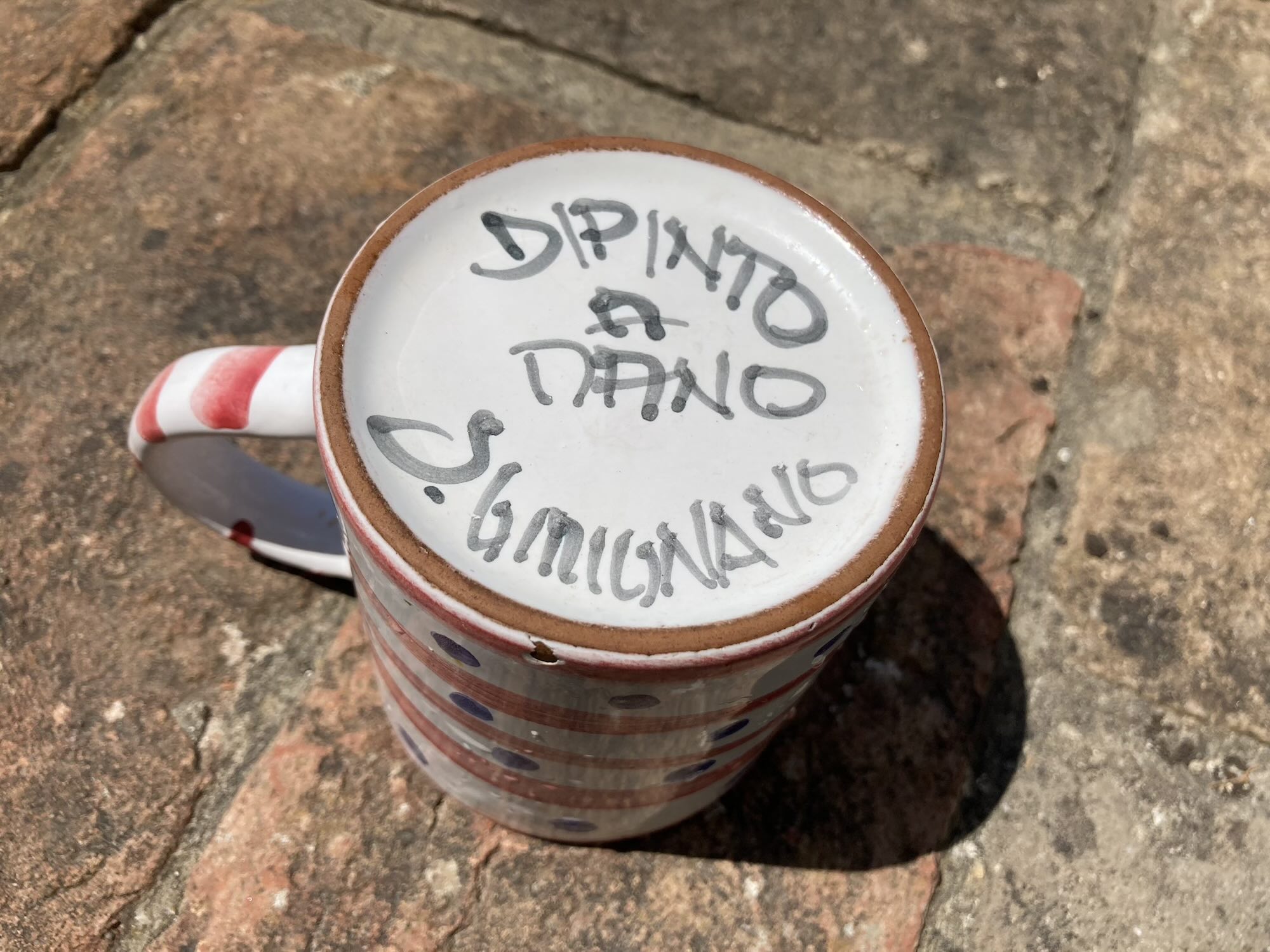
Some verbs also belong to the mano family. Maneggiare means “to handle,” “to operate,” or “to manipulate.”
Eh, questo è uno strumento tipico per maneggiare gli spaghetti o la pasta lunga.
Uh, this is a typical instrument for handling spaghetti or long pasta.
Captions 106-107, L'Italia a tavola Tonnarelli cacio e pepe - Part 1
Play Caption
At first, mantenere might not look as though it belongs to the same family. However, it comes from the Latin expression "manu tenere," meaning “to hold in the hand.” This helps explain why mantenere can mean “to maintain,” “to keep,” or “to support,” depending on the context.
Io non posso fidarmi di chi non può mantenere le promesse.
I can't trust someone who doesn't keep his promises.
Captions 15-16, Imma Tataranni Sostituto procuratore S1 EP4 Maltempo - Part 19
Play Caption
We also use mantenere to mean “to support,” as in parents financially supporting their children.
Ma come faccio a mantenere un figlio?
But how can I support a child?
Caption 25, Com'è umano lui Film - Part 10
Play Caption
If you do a search of mantenere (and the different conjugations, too), you'll find a wide variety of examples, with different contexts and nuances.
Per salire si paga un ticket, che serve per la bonifica e la manutenzione del sentiero.
To go up one buys a ticket, which is used for the reclaiming and maintenance of the trail.
Caption 28, Linea Blu Le Eolie - Part 16
Play Caption
When you have work done at home, it's typical to divide the bill into i materiali (the materials) and la manodopera (the labor). The word is made up of mano (hand) (that does the work) and d'opera (of the work, the job). It has become one word (univerbazione) but clearly was 3 separate words at one time. The word can also be written mano d’opera and refers either to the workers performing a job or to the cost of their labor.
Chi la paga la stoffa e la manodopera?
Who will pay for the fabric? And the labor?
Caption 41, Sposami EP 4 - Part 17
Play Caption
Italian is full of word families like this one. The more you notice the connections between related words, the easier it becomes to guess meanings and build your vocabulary naturally.
Thanks for reading. Write to us at [email protected].

If you've ever walked down an Italian street, you’ve seen this sign a thousand times: passo carrabile. But have you ever actually stopped to think about what it really means? Passo is pretty clear; it has to do with "passage." Note: The noun passo has multiple meanings, and it's also the first-person singular conjugation of the verb passare.
Mi state bloccando il passo.
You are blocking my way.
Caption 1, Caravaggio EP 2 - Part 18
Play Caption
But what does carrabile mean? It’s not a word we learn in standard language apps, and we don't really need to know what it means, literally. We just need to know we can't block that passageway.
The question that led to this lesson was, upon looking at the passo carrabile sign up close: Does carrabile have anything to do with carreggiata (a word you learn at the scuola guida)? The answer is yes.
But if we unlock the root of these words, lots of other words will come into focus, and we'll even see a connection between ancient Rome and modern Italian life.
As English speakers, we could easily find a hidden cognate-type word in carreggiata: carriage or chariot (by way of French). These words all go back to the same word ancient Romans adopted from the Celtic word for a wheeled wagon: "carrus." The Latin word "carrus" became carro in Italian, the word for "cart," as well as "chariot."
E si vede un'incredibile scena di corsa di carri,
And you see an incredible chariot race scene,
Caption 9, Meraviglie EP. 4 - Part 12
Play Caption
The following example is part of a description of the flooding of the Po River in 1951.
Ma quando il Po si gonfiava e usciva dagli argini rimaneva poco da fare. Caricare sui carri le poche cose e aiutarsi l'un l'altro.
But when the Po would swell and rise above its banks, there was little left to do. Load one's few possessions onto carts and help each other.
Captions 25-26, L'arte della cucina Terre d'Acqua - Part 3
Play Caption
Carro is used today for the floats you see in parades or processions.
Come vedi c'è il carro di Santa Rosalia...
As you can see, there's the Saint Rosalia [patron saint of Palermo] float...
Caption 25, Dottor Pitrè e le sue storie - Part 2
Play Caption
It's also used when talking about funerals. It carries the coffin.
Sarà mica un carro funebre?
It wouldn't be a hearse, would it?
Caption 64, Provaci ancora prof! S1E2 - Un amore pericoloso - Part 12
Play Caption
In Italy, when you do the grocery shopping, you frequently use un carrello.
Se devi acquistare poche cose, non c'è bisogno di prendere il carrello della spesa, ma è meglio utilizzare un cestino.
If you have to buy just a few things, there is no need to get a shopping cart, but it is better to use a basket.
Captions 29-31, Vocaboliamo Supermercato - Part 2
Play Caption
If you do any gardening, you probably use una carriola (a wheelbarrow).
Carreggiata: La carreggiata might not be a word you need to know, unless you are studying to get an Italian driver's license (la patente di guida), but it is useful for understanding what carrabile means.
Do you see the suffix -ata in carreggiata? In Italian, that often means a collection or the space made by something. Historically, la carreggiata was the specific 'wagon track'—the part of the road wide enough for heavy carts. Today, it means the structural roadbed meant only for cars.
Le luci dei lampioni che vede sfilare sul bordo della carreggiata gli sembrano degli oggetti volanti non identificati.
The lights of the street lamps that he sees going past along the edge of the roadway look like unidentified flying objects to him.
Captions 2-3, Fulvio Benelli Crimine Infinito, romanzo - Part 3
Play Caption
Un passo carrabile is a passageway accessible to vehicles. In order to claim that space, you need to have authorization from the town.
If you park in a passo carrabile, you might get a ticket or you might get your car towed away by un carro attrezzi.
Ho capito la situazione, ma non... Chiama il carro attrezzi, il soccorso stradale, qualcosa.
I understand the situation, but I can't... Call the tow truck, the roadside assistance, anything.
Captions 38-39, Provaci ancora prof! S2E5 Vita da cani - Part 4
Play Caption
You might see this as two words: carro attrezzi, but it is common to see it as one word: carroattrezzi. It's also called il soccorso stradale (roadside assistance).
Carrozza: The translation is "carriage," and it's the way people traveled before there were trains or cars (horseless carriages). The cart became a carriage. The humble carro became the more elegant carrozza. It was bigger, enclosed, and more complex than a cart and was designed for people. Nowadays, the word is used for an individual carriage, coach, or car of a train. On your ticket, you might see the word carrozza and a number. For example, carrozza 04, posto 41 finestrino (car 4, seat number 41, window seat).
There are plenty of words related to carrozza.
The carrozziere fixes up the body of the car.
Va bene, allora parlo un attimo col carrozziere.
All right. So I'll have a quick word with the body shop guy.
Caption 16, Provaci ancora prof! S1E3 - Una piccola bestia ferita - Part 14
Play Caption
The carrozzeria is the body of the car, the outside, as well as the body shop.
Ah, e c'erano anche dei graffi sulla carrozzeria.
Oh, and there were some scratches on the body.
Caption 21, Francesca alla guida - Part 1
Play Caption
Carrozzella is one of the words for wheelchair, and also means "horse-drawn buggy."
Qua, tolto il figlio con la madre in carrozzella non s'è visto nessuno.
Here, apart from the son with his mother in a wheelchair, I didn't see anyone.
Caption 15, Imma Tataranni Sostituto procuratore S1 EP3 I giardini della memoria - Part 15
Play Caption
When you go to buy or rent una sedia a rotelle (a wheelchair), it is commonly called una carrozzina.
Come operatore socio sanitario, il mio lavoro consiste nel [sic: nello] stare vicino ai pazienti, nel lavarli, nel vestirli, nel portarli in carrozzina...
As a public healthcare worker, my job involves being there for patients, in washing them, dressing them, in taking them around in a wheelchair...
Captions 22-26, COVID-19 1) Il contagio
Play Caption
La carrellata is a term used in cinema for dolly or tracking shots.
Un bacio al piccolo Robertino e il film motoristico di Rossellini si conclude con una carrellata verso il focolare domestico.
A kiss for the little Robertino and Rossellini's car film concludes with a tracking shot towards the home fires.
Captions 50-51, La Mille Miglia del passato per vivere quella di oggi - Part 2
Play Caption
Even the verb caricare (to load, to charge) comes from that same root, "carrus." Originally, it was "to load up a cart or wagon."
E abbiamo... l'abbiamo caricato nel bagagliaio dell'auto.
And we... we loaded it into the trunk of the car.
Captions 9-10, Provaci ancora prof! S2E6 La strana ossessione - Part 22
Play Caption
Look at all the words from just one root: carro, carrello, carriola, carrabile, carreggiata, carrozza, carrozziere, carrozzeria, carrellata, caricare. Rather than thinking of the English word, try visualizing what they are or what they do.
We close this collection of related words with an Italian saying: mettere il carro davanti ai buoi (to put the cart before the oxen), which is also popular in English, but with horses in place of oxen — Il risultato non cambia (the result is the same).
Thanks for reading. You can write to us at [email protected]. We love to hear from you.

In our previous lesson, we tackled a unique Italian grammar collision: using a reflexive verb inside an impersonal statement. This happens when two conditions meet:
1) We use a reflexive verb like vestirsi (to dress oneself), where si is part of the verb.
2) We want to speak impersonally ("people in general"), which also requires the subject si.
When these two si particles collide, the first one changes to ci:
si + si veste → ci si veste
Other Ways to Say the Same Thing:
To see, close up, how this structure compares to other common subject pronouns and nouns, let's look at these alternative options:
Uno si veste a cipolla per fare trekking. (using the singular pronoun uno — someone): "Someone/a person dresses in layers...")
Una persona che va a fare trekking si veste a cipolla. (using a singular noun una persona: "A person dresses...")
La gente, quando fa trekking, si veste a cipolla. (using the collective singular noun la gente: "People dress...")
Le persone che fanno trekking si vestono a cipolla. (using the plural noun le persone, which forces the verb into the plural si vestono: "People dress...")
Ci vestiamo a cipolla quando facciamo trekking. (using the "we" form: "We dress [ourselves] in layers..." Here, ci actually does mean "us/ourselves!")
Ci si veste a cipolla quando si fa trekking. (impersonal + reflexive combo: "One dresses in layers when one goes hiking.")
The New Twist
We closed the previous lesson with this example:
E come tanti altri italiani, il ventiquattro sera, verso le sette, ci si mette a cena, e si mangiano pietanze a base di pesce.
And like many other Italians, the evening of the twenty-fourth, around seven, one sits down to dinner, and one eats dishes with fish as their basis.
And like many other Italians, the evening of the twenty-fourth, around seven, people sit down to dinner, and dishes with fish as their basis are eaten.
Captions 5-8, Marika spiega La Vigilia di Natale
Play Caption
Notice the second highlighted phrase:
si mangiano pietanze
Unlike ci si mette, this is not a reflexive construction. However, it can still be considered impersonal because no specific person is mentioned as the "actor."
❗️The important thing to notice is that the direct object (pietanze) is plural.
This creates what we might call the Plural Object Trap.
The Rule
When the direct object is singular, the verb remains singular:
Si mangia la pizza in pizzeria o a casa.
One can eat pizza in a pizzeria or at home.
Pizza can be eaten in a pizzeria or at home.
But when the direct object is plural, the verb flips to the plural:
Si mangiano tanti tipi di pizza in quella pizzeria.
One can eat many types of pizza in that pizzeria.
Many types of pizza can be eaten in that pizzeria.
➡️ A note about si passivante
If you've studied Italian grammar before, you may have come across the term si passivante.
In practice, however, you don't need to worry too much about the label. The important thing to notice is that when a plural direct object appears in relation to si, the verb agrees with it:
Si mangia la pizza.
Si mangiano molti tipi di pizza.
You can think of it this way: the focus shifts from the people doing the action to the thing being acted upon (the pizza, types of pizza). For learners (and non-grammar nerds), recognizing this plural agreement is much more useful than memorizing grammatical terminology.
And here is a great example from a Yabla video that, in one single sentence, features 3 different ways we use the impersonal reflexive. We looked at the first 2 ways in the previous lesson, so pay close attention to the 3rd way.
ci si rilassa → reflexive verb rilassarsi (to relax) in the impersonal third person.
si legge → standard verb in the impersonal (third person singular) form.
si fanno tante attività. → the object (attività) is plural, so the verb agrees with it and becomes plural: fanno.
Questa è la stanza in cui ci si rilassa, si legge, si fanno tante attività.
This is the room in which one relaxes, one reads, one does many things.
Captions 2-3, Marika spiega Il salone
Play Caption
Here are two examples using the verb vedere (to see).
Singular object: la città (the city)
Si vede tutta la città?
Can one see the whole city?
Can the whole city be seen?
Caption 2, La compagnia del cigno S2 EP 2 - Part 13
Play Caption
Plural object: gli affreschi (the frescoes)
E si vedono ancora degli affreschi di allora.
And one still sees frescoes from that time.
Frescoes from that time are still visible.
Caption 14, Meraviglie EP. 1 - Part 14
Play Caption
Below is an example with the verb vendere (to sell).
Singular object: l'appartamento (the apartment)
Ma l'appartamento si vende, Le interessa?
But the apartment is for sale. Are you interested?
Caption 65, Imma Tataranni Sostituto procuratore S1 EP5 Rione Serra Venerdì - Part 11
Play Caption
Plural object: i dischi (the CDs)
I dischi non si vendono più.
CDs are no longer selling.
Caption 51, Chi m'ha visto film - Part 2
Play Caption
One verb you'll encounter all the time in this construction is parlare. Walk through a city like Rome or Florence and you may see signs that say:
Qui si parla inglese.
English is spoken here.
They speak English here.
The object (inglese) is singular, so the verb remains in the singular.
In the following two examples, Marika is playing the teacher, and Anna, the student.
Singular object: il dialetto (the dialect)
Che dialetto si parla a Milano?
What dialect do they speak in Milan?
What dialect is spoken in Milan?
Caption 37, L'Italia a tavola Interrogazione sulla Lombardia
Play Caption
Plural object: i dialetti (the dialects)
In Puglia si parlano tanti dialetti.
In Puglia, many dialects are spoken.
In Puglia, they speak many dialects.
Caption 32, L'Italia a tavola Interrogazione sulla Puglia
Play Caption
What Should You Listen For?
When you hear an impersonal construction with si, your first instinct may be to expect a singular verb:
Si mangia.
Si parla.
Si vede.
And most of the time, you will be right.
But now you know the trap.
If a plural direct object enters the sentence, the verb often switches to the plural:
Si mangiano pietanze.
Si vedono affreschi.
Si parlano dialetti.
Si fanno attività.
The good news is that you don't have to stop and analyze whether you're dealing with a si impersonale or a si passivante. Instead, try training your ear to notice a simpler pattern:
Singular object → singular verb
Si parla inglese.
Si vende l'appartamento.
Si vede la città.
Plural object → plural verb
Si parlano molti dialetti.
Si vendono i dischi.
Si vedono gli affreschi.
As you watch Italian videos and listen to native speakers, keep an ear out for these forms. The more examples you hear, the more natural they will begin to sound. Before long, you'll stop thinking of them as grammar rules and start recognizing them as just another way Italians talk.
Alla prossima!
Thanks for reading. You can write to us at [email protected].
We love to hear from you. Ci piace tantissimo sentirvi!

Talking About People in General (the ci si formula)
When you want to talk about people in general and what they do, there are various options in Italian. Let's kick off the lesson with a common fact: Italians eat a lot of pasta.
We can say:
Gli italiani mangiano tanta pasta (Italians eat a lot of pasta).
In Italia, quasi tutti mangiano la pasta (in Italy, almost everyone eats pasta).
But we have another very popular option. Instead of specifying anyone in particular with nouns like "Italians" or "everyone," we can use a special formula to talk about what "people in general" do. We do this by placing the little word (also called a "particle") si right before a third-person singular verb. Here it is in action:
In Italia, si mangia tanta pasta.
Even though it translates to "In Italy, people eat a lot of pasta," this formula with si functions a bit like the English word "one" (as in, "one eats a lot of pasta in Italy"). The basic rule for this general si structure is that the verb stays in the third-person singular almost all the time (with some exceptions we'll get to later).
And if you are ever a guest in an Italian home, you will definitely hear someone call out:
"Si mangia!" It means "it's time to eat!" or "The food's on the table!"
Literally, it translates to "one eats," making it the ultimate everyday example of this structure in action.
Now we know that when we're talking about people in general performing an action, we can just put si in front of the third-person singular verb, such as si mangia (one eats/people eat) or si viaggia (one travels/people travel).
"Ormai si viaggia più spesso in aereo",
"These days, one travels more and more often by plane,"
Caption 32, Corso di italiano con Daniela La forma passiva - Part 3
Play Caption
The Grammar Collision: When Reflexive Verbs Join the Party
So far, the verbs we've talked about have been, let's say, standard verbs. But what happens when the verb we want to use with a si formula is already a reflexive verb? That's when the "collision" happens.
That's because we also use this same particle, si, when conjugating reflexive verbs, those verbs in which the subject and the object are the same. ➡️ Learn about reflexive verbs in this lesson, and how to conjugate them in this lesson.
When we conjugate a verb like svegliarsi (to wake up), we need si.
Tutte le mattine si sveglia con il cuscino pieno di lacrime.
Every morning she wakes up with her pillow full of tears.
Caption 42, Volare - La grande storia di Domenico Modugno Ep. 2 - Part 15
Play Caption
So when we have a conjugated reflexive verb where we need si AND an impersonal formula where we need si, we have a unique kind of grammar collision.
In other words:
1) We use a reflexive verb like vestirsi (to dress oneself), where si is part of the verb. For example: Di solito, una persona che fa trekking si veste a cipolla (usually, a person who goes hiking dresses in layers).
2) We want to speak impersonally ("people in general"), which also requires the subject si (as we illustrated earlier in the lesson).
In essence, we want to combine the impersonal subject with a reflexive verb. So we try it out: Di solito si si veste a cipolla...
But that does not cut it. It is not good Italian. To Italians, repeating si - si doesn't work. To make it sound better, Italian grammar requires always changing the first particle in a double-pronoun chain. Since the reflexive pronoun si is stuck tightly to the verb, it stays where it is, and it is actually the first si (the impersonal one) that changes to ci.
So this is the process:
⚠️ It's easy to confuse this grammatical ci with the word ci meaning "us." In fact, this is just one of the many ways we use ci in Italian! ➡️ For more on ci, see this lesson!
Real-World Examples from the Wild
Let’s look at how we use this ci-si trick with everyday verbs: divertirsi (to have fun), svegliarsi (to wake up), riposarsi (to rest), sentirsi (to feel).
A Dixieland ci si diverte con poco e nulla.
At Dixieland one has fun with next to nothing.
Caption 30, Dixiland La magia di Tribo
Play Caption
E, no. -No, domani è domenica, ci si sveglia tardi, -E sì. -ci si riposa.
No. -No, tomorrow is Sunday, one wakes up late, -Yes. -one rests.
Captions 45-46, La compagnia del cigno S2 EP 2 - Part 11
Play Caption
E... volevo chiederti, come ci si sente da sposati?
And... I wanted to ask you, how does one feel, married?
Captions 52-53, Sposami EP 5 - Part 16
Play Caption
In this next example, the speaker is using the impersonal form to speak in general about modern life, using "one" in the third-person singular.
Note that the last 2 verbs are reflexive verbs: vestirsi (to dress) and pettinarsi (to style one's hair), so for the first 2 verbs — viaggiare (to travel) and parlare (to talk), there is just the impersonal si, and for the last 2, we find ci si, in other words, both the impersonal si transformed into ci and the reflexive si.
Perché qua sta cambiando un po' tutto. -Sì, e... Come si viaggia, come si parla, come ci si veste, come ci si pettina.
Because here, everything is kind of changing. -Yes, and... The way one travels, the way one talks, the way one dresses, the way one styles one's hair.
Captions 11-13, Volare - La grande storia di Domenico Modugno Ep. 1 - Part 23
Play Caption
A Sneak Peek into the next lesson on this topic:
Here is an example using the verb mettersi (a very common reflexive form of mettere — to put), meaning to sit down/set oneself to a task. Pay close attention to the second half of this sentence:
E come tanti altri italiani, il ventiquattro sera, verso le sette, ci si mette a cena, e si mangiano pietanze a base di pesce.
And like many other Italians, the evening of the twenty-fourth, around seven, we sit down to dinner, and one eats dishes with fish as their basis.
Captions 5-8, Marika spiega La Vigilia di Natale
Play Caption
Did you spot the twist? The phrase si mangiano refers to an object in the plural (le pietanze - the dishes), so the verb magically flips to the plural to agree with it! This takes some getting used to, and it brings us to our next big topic...
The Plural Object Trap: If people are acting on multiple objects, the verb unexpectedly flips to the plural!
Standard: Ci si prepara un caffè. (One prepares a coffee.)
The Trap: Ci si preparano tre caffè. (One prepares three coffees.)
When you are out in the wild watching Italian videos or chatting with locals, don't worry about memorizing heavy grammar terms. Just remember our two simple visual tricks:
The si-si fix: When a verb is reflexive and impersonal, change that first si to ci to keep things flowing smoothly (ci si veste).
The order rule: The front word (ci) means "people in general," and the back word (si) stays glued to the verb.
In our next lesson, we are going to dive deeper into that final example. We will unpack exactly why si mangia suddenly transforms into si mangiano when plural objects enter the room. Until then, keep your ears open for the ci-si trick. Alla prossima!
Thanks for reading. Write to us at [email protected]. We love to hear from you!

In a recent episode of Romanzo italiano, there is a noun with an S-prefix that we perhaps haven't seen before. It's a word we encounter quite often, however, as we travel around Italy: la sbarra. We can perhaps figure out that it comes from barra, which resembles the noun "bar" — not the kind of bar where one can have a drink, but a physical bar, that's long and narrow.
Clicca su "Play" o semplicemente premi sulla barra spaziatrice della tua tastiera.
Click on "Play" or simply press the space bar on your keyboard.
Captions 5-6, Tutorial Yabla Comandi base del riproduttore
Play Caption
Barra also means "slash," as in a URL. We can use it in casual conversation to indicate a range or option. Here too, it could be translated as "slash."
E io, naturalmente, ho già preparato un impasto perché deve lievitare, deve lievitare almeno due barra tre ore,
And naturally, I already prepared a batch of dough because it has to rise, it has to rise for at least two to/slash three hours,
Captions 66-67, L'Italia a tavola Panzerotti Pugliesi - Part 1
Play Caption
Barra can also be part of an address, un numero civico: For example, one address might be via nuova, 41 and another address nearby might be via nuova, 41/A — quarantuno barra A.
Barrare is a verb we use when we cross off an item from a list, or when we check a box on a multiple-choice quiz. We often make a slanted line (that is naturally, narrow and long).
We have seen that the S- prefix can give a negative value to a word, whether it be a noun, verb, or adjective. But it can also reinforce the meaning.
Finché Lei resta lì, no, mi sbarra la strada.
As long as you stay there, no. You're blocking my path.
Caption 37, Volare - La grande storia di Domenico Modugno Ep. 1 - Part 11
Play Caption
The noun la sbarra is the gate or barrier that blocks you from crossing a threshold until you get a ticket, pay, or show some ID. We find una sbarra in parking lots, toll booths, private driveways, level crossings, and yes, prisons, as in the following example.
Alla sbarra, quando mi fermo per farmi riconoscere, mi viene da abbassare gli occhi e la vedo alzarsi con uno sforzo enorme, quella sbarra.
At the barrier, when I stop to identify myself, it makes me want to lower my eyes and I see it rise with enormous effort, that barrier.
Captions 37-41, Romanzo Italiano Campania - Part 3
Play Caption
Può dirsi fortunato chi imbocca un passaggio a livello un attimo prima che calino le sbarre.
He can count himself lucky, whoever crosses a railroad crossing an instant before the barriers are lowered.
Caption 28, La Mille Miglia del passato per vivere quella di oggi - Part 2
Play Caption
And since prison bars are used to block inmates from leaving, sbarre is used for these, too.
In this example, journalist Oriana Fallaci is talking about the conditions of Muslim women in Islamic countries.
Attraverso quei buchi, le donne guardano il cielo come attraverso le sbarre di una prigione.
Through these holes, the women look at the sky as through the bars of a prison.
Captions 3-4, L'Oriana film - Part 4
Play Caption
And here, Alberto Manzi is teaching young kids in a juvenile detention center.
Se guardi il cielo, non ci sono sbarre, non ci sono muri.
If you look at the sky, there are no bars, there are no walls.
Captions 22-24, Non è mai troppo tardi EP1 - Part 12
Play Caption
La sbarra can be negative and imply being imprisoned, but it's also commonplace in so many places where there is no free passage, so it's a good word to have in your toolbox, along with its variants.
Thanks for reading. Write to us with questions and ideas at [email protected].

It's easy to get confused between two similar verbs, supportare and sopportare, especially since they both look similar to the English verb "to support." As a matter of fact, they also both come from the same Latin roots: the Latin prefix "sub-" (meaning "under" or "from below") combined with "portare" (meaning "to carry"). There are other Italian and Latin words with variant spellings, so that's not so unusual, but supportare and sopportare had different evolutions and now have different meanings.
Supportare is a cognate of the English "support," in both physical and figurative senses. It gives a sense of aid, and therefore, of something positive.
La Space Station è fornita di enormi pannelli solari, pannelli fotovoltaici che generano l'energia necessaria per supportare tutta l'infrastruttura e gli astronauti a bordo della stazione orbitale.
The Space Station is equipped with huge solar panels, photovoltaic panels, which generate the necessary energy to support the entire infrastructure and the astronauts aboard the orbital station.
Captions 67-71, Space to ground EP2 Energia dell'universo. Luce - Part 2
Play Caption
Ma ci sono state anche tutte delle cose che sono nate per supportare le famiglie degli operai.
But there have also been all the things that were created to support the families of the workers.
Captions 76-78, Romanzo Italiano Campania - Part 3
Play Caption
There is a noun form as well: il supporto
No, io volevo ri'... chiaramente ringraziare la dottoressa Piras per il supporto che ci ha dato durante tutto il nostro processo investigativo.
No, I wanted, of course, to thank Doctor Piras for the support she gave us during our entire investigative process.
Captions 7-9, I Bastardi di Pizzofalcone S1EP1 I Bastardi - Part 26
Play Caption
Here are some synonyms for supportare when it's physical or structural:
And here are synonyms when supportare has to do with people, ideas, projects, etc.
Although stemming from the same Latin root, sopportare has an entirely different meaning from supportare. The English word "to bear," with its different connotations, does provide some overlap, however.
Sopportare tends to express a sense of bearing something negative, enduring or tolerating an emotional burden, for example, but also a physical one.
Livietta è troppo piccola per sopportare il peso di un divorzio.
Livietta is too young to bear the burden of a divorce.
Caption 11, Provaci ancora prof! S1E3 - Una piccola bestia ferita - Part 19
Play Caption
È quando torni dall'ufficio col muso lungo che proprio non ti sopporto.
It's when you come back from the office with a long face that I just can't stand you.
Captions 44-45, Com'è umano lui Film - Part 18
Play Caption
Sopportare has some synonyms, some of which overlap with supportare. Read about one of them, reggere, in this lesson.
In everyday conversation, sopportare will likely be the verb we hear more often, especially in reference to relationships. But as English terminology gains standing in the Italian language, especially in the area of psychology and therapy, supporto is used more and more often, especially in contexts such as the following: support group = gruppo di supporto.
Insomma, il bastardo t'ha fatto un gruppo di supporto perché non suoni abbastanza bene.
So, basically, the bastard made a support group for you because you don't play well enough.
Captions 27-28, La compagnia del cigno S2 EP 2 - Part 3
Play Caption
A common synonym for the noun il supporto is il sostegno.
Questo prodotto si caratterizza della fatica [sic: è caratterizzato dalla fatica] di molti uomini che hanno la capacità di trasformare scarti di produzione alimentare in un prodotto nobile, capace di dare sostegno al cammino dell'uomo.
This product is characterized by the efforts of many men who have the ability to transform food production waste products into a noble product, capable of giving support to man's stride.
Captions 13-16, L'Italia che piace Stile di vita - Part 4
Play Caption
In English, we can talk about a support group, but we can also say someone is being supportive. In this case, too, we can use di supporto. Or we can say solidale.
Dobbiamo essere solidali.
Dobbiamo essere di supporto.
We have to be supportive.
Caption 56, Sposami EP 3 - Part 20
Play Caption
Let's not overlook a very important adjective we use to describe a person or situation: insopportabile, used more often in its negative form. We have used "unbearable" as the English translation, but we can also use "obnoxious," "intolerable," "insufferable," and other similar adjectives.
Melissa è insopportabile,
Melissa is unbearable.
Caption 3, JAMS S1 EP1 - Part 4
Play Caption
A positive form of the adjective exists as well. It's used a lot when referring to pain. Is it bearable? È sopportabile?
Ma vedi, il mondo è diviso in due categorie: quelli come te, che cercano di renderlo migliore, e quelli come me che cercano solo di renderlo sopportabile.
But you see, the world is divided into two categories: the ones like you, who try to make it better and the ones like me who just try to make it tolerable.
Captions 61-63, Il Commissario Manara S1EP6 - Reazione a Catena - Part 3
Play Caption
We hope this lesson hasn't been too insopportabile. We just want to be di supporto, in other words, supportive.
Questions? Comments? Write to us at [email protected]. We love to hear from you!

Here's a word to know that has a mundane literal meaning, but it also has a figurative meaning that's good to know about. Let's get into it.
The adjective digiuno derives from the Latin "ieiūnus," which means "on an empty stomach" (abstaining from eating), "sterile," or "arid." The noun il digiuno comes from the verb digiunare (to abstain from eating, starving). Although digiuno can be used as an adjective, it's more often used as a noun as we will see below.
Fare un digiuno is to fast, to carry out or to go on a fast.
Noi musulmani facciamo digiuno dall'alba al tramonto.
We Muslims fast from dawn to dusk.
Caption 63, La Ladra EP. 6 - Nero di rabbia - Part 4
Play Caption
E non parlarmi di diete e digiuno. Voglio tante curve come in Formula Uno
And don't talk to me about diets and fasting. I want as many curves as in Formula One
Captions 19-20, Radici nel Cemento Bella Ciccia
Play Caption
Quello è il dottor Rapisarda, che ha detto che dovevi osservare un digiuno assoluto.
That is Doctor Rapisarda who said you had to observe a total fast.
Captions 49-50, La linea verticale EP 5 - Part 6
Play Caption
But essere a digiuno is slightly different. It can be used literally, for example, when you are about to have an exam or operation at the hospital, and you may have to have an empty stomach: essere a digiuno (to have an empty stomach).
And it can imply hunger. In this case, we are talking about the wild animals in the Colosseum, back in Roman times.
Che cos'erano... il condannato, pensa qui, veniva sbranato da belve inferocite, lasciate a digiuno per l'occasione.
What were they? The condemned person, just think, was torn to pieces by enraged wild beasts, left unfed for the occasion.
Captions 12-13, Marika e Daniela Colosseo, interno - Part 2
Play Caption
In the clip below, Eva, the owner of the restaurant, has had some shocking news and wants a glass of wine. But she hasn't eaten yet. Wine bottles always provide the percentage of alcohol, which normally ranges from 11 to 14%.
È un corruttore di gioventù. Oddio. Eva, guarda che a digiuno dodici gradi e mezzo non sono pochi, eh.
He corrupts young people. Oh my God. Eva, look, on an empty stomach, a twelve point five percentage is not nothing, huh.
Captions 34-36, La Ladra EP. 2 - Viva le spose - Part 6
Play Caption
But a digiuno is also used figuratively to say you don't know anything about something, you're uninitiated, completely new to something, or clueless.
E poi quando ho iniziato questo lavoro io ero completamente a digiuno su aspetti, diciamo così, di protocollo.
And then when I started this job I was completely clueless about aspects, let's say, of protocol.
Captions 1-3, Ritratti Fabiola Gianotti - Part 18
Play Caption
Thanks for reading. Write to us with questions and comments to [email protected].

Lasciare and partire both mean "to leave." So, what's the difference, if any?
Actually, there is a big difference, especially in grammatical terms. Lasciare is a transitive verb, meaning it takes a direct object. You leave a place, a thing, a person. Other meanings are: "to abandon," "to leave behind," "to let," "to let go," or "to allow."
Tanto anche se mi cacciano non mi importa, mia madre vuole che lasci Milano.
In any case, if they kick me out, I don't care. My mother wants me to leave Milan.
Captions 5-6, La compagnia del cigno EP 6 - Part 10
Play Caption
When forming compound tenses, the auxiliary verb avere (to have) is used.
Tu hai finalmente lasciato quel tuo inutile fidanzato, e tua madre ed io ne siamo stati felici per te.
You finally left that useless boyfriend of yours and your mother and I were happy about that for you.
Captions 65-67, I Bastardi di Pizzofalcone S1 EP6 Buio - Part 11
Play Caption
When you want someone to get off your back, either physically or figuratively, lasciare is a good verb to use.
Ma come ti... -Guarda che ti posso pagare... -Lasciami!... -te l'ho detto. Lasciami!
But how... -Look, I can pay you... -Let me go!... -I told you. Let me go!
Captions 24-25, I Bastardi di Pizzofalcone S1EP5 Misericordia - Part 28
Play Caption
But this expression can be expanded, too:
Ma come ti sei vestita? -Ehi, lasciami stare.
But how did you dress? -Hey, leave me be.
But how did you dress? -Hey, leave me alone.
Captions 40-41, La compagnia del cigno EP 5 - Part 15
Play Caption
Lasciatemi stare!
Let (plural) me be!
Caption 13, La compagnia del cigno EP 6 - Part 10
Play Caption
Here's another common way to say "leave me alone."
Lasciami in pace.
Leave me alone (literally, "leave me in peace").
Caption 80, Com'è umano lui Film - Part 30
Play Caption
Of course, in English, when we say "leave me alone," we don't mean literally "alone," we mean, "stop bothering me," or "get off my back."
Attenzione! We can also use the reflexive form of lasciare: lasciarsi, which can either mean to let yourself do something, as in the following example:
La gente quando mangia, si lascia andare, non tiene difese e io la guardo.
When people eat, they let themselves go, they let their guard down and I observe them.
Captions 35-36, I Bastardi di Pizzofalcone S1EP2 Rabbia - Part 4
Play Caption
Note that when we use the reflexive form lasciarsi, we use the auxiliary essere (to be).
Da quando a Cappellini era morta la moglie, si era lasciato andare in un modo decisamente eccessivo.
Since Cappellini's wife died, he had let himself go in such a way [that was] decidedly excessive.
Captions 10-12, Provaci ancora prof! S2E3 Dietro la porta - Part 16
Play Caption
We can use lasciarsi reciprocally, as when a couple breaks up.
No, ci siamo lasciati.
No, we broke up.
Caption 91, Provaci ancora prof! S3EP3 La terza vittima - Part 4
Play Caption
Partire, on the other hand, is an intransitive verb. No direct object here.
Devo partire con lei.
I have to leave with her.
Caption 7, La compagnia del cigno EP 6 - Part 10
Play Caption
Purtroppo martedì noi partiamo per Londra.
Unfortunately, on Tuesday we leave for London.
Caption 11, Sposami EP 3 - Part 6
Play Caption
We use the verb partire to mean "to start," as in a car not starting:
Problemi, prof? -E sì, non parte.
Problems, Prof? -Yes, it [the car] won't start.
Captions 53-54, Provaci ancora prof! S3EP2 Doppio imprevisto - Part 3
Play Caption
But we also use it when we want to start doing something, such as a race, a competition, a discussion, or when we start rehearsing a musical piece together.
Partiamo con gli assaggi dei vostri arancini.
We'll begin with tasting your rice balls.
Caption 2, JAMS S1 EP4 - Part 3
Play Caption
We hope you have a better idea about the difference between lasciare and partire. This is a partial picture, as both of these verbs are used in various situations, with nuanced meanings. Write to us with your questions or comments. We love to hear from you: [email protected].

Have you ever noticed that Italians use a little pronoun even after they have already mentioned the noun in a sentence? Have you ever thought it was either bad grammar or just a regional habit? Or maybe you never even noticed an "extra" object was there (easy to do if you aren't following along with the transcript).
I certainly thought these seemingly extra pronouns were a kind of clutter, little words people would just add through habit. 🔎 But then I took a closer look. I discovered that they are not clutter at all. They are connectors.
In conversation, Italians often put the object first and refer back to it with a pronoun. These little pronouns aren't thrown into a sentence at random. They appear because the speaker has changed the usual order of the sentence.
Let's look at an example from the popular series La compagnia del cigno, where Maestro Marioni is being hard on a new violinist in his conservatory orchestra. Note the position of the object (le note) in this straightforward word order. The object comes after the verb — standard.
Dovresti sapere le note a memoria, no (you should know the notes by heart, right)?
But Maestro Marioni puts the object first, a very common practice:
Le note le dovresti sapere a memoria, no (you should know the notes by heart, right)?
When the object (in this case le note — the notes) gets moved away from its usual position after the verb, an object pronoun referring to the object is used to keep the connection clear. It's kind of like an echo. It's a reminder of the object that's already part of the sentence.
(In the video, you may hear Maestro Marioni hesitate: "Le, le note..." This first le is just a false start, something we often do in spontaneous speech.)
Sei rigido. E poi non guardare lo spartito, no? Le, le note le dovresti sapere a memoria, no?
You're stiff. And then, don't look at the score, OK? The, the notes, you should know them by heart, no?
Captions 50-52, La compagnia del cigno S1 EP4 La scelta di Barbara - Part 3
Play Caption
➡️ Here's what we're talking about:
What is it? An object pronoun.
What is happening? The object and the verb are separated because the speaker has changed the usual word order.
Why is the pronoun there? It helps maintain the connection and keeps the listener oriented.
How can we think of it? Like an echo.
In the following example, a fisherman is talking about his world, the sea. He doesn't use the usual word order, subject - verb - object. He starts with the object, il mare (the sea). Since the object is no longer in its usual place, the speaker quite naturally echoes that object with a pronoun that represents it. We could say it's a way of orienting the listener.
Eh, il mare tu lo scegli come unica fidanzata, poi te la sposi e ci resti tutta la vita.
Uh, you choose the sea like a sole girlfriend, then you marry her and you stay your whole life.
Captions 65-66, Dottor Pitrè e le sue storie - Part 2
Play Caption
He could have said,
Tu scegli il mare come unica fidanzata... (you choose the sea like a sole girlfriend...)
But he chose to begin with the word that came to mind first: il mare (the sea).
This is normal practice in Italian. And now that you know it's normal, you will start hearing and seeing it more and more often.
This next example is a slightly more complex sentence. Author Valeria Parrella could have said, using the usual word order:
... non puoi fare una fotografia (...you can't take a photograph).
She switched the word order around quite a bit. In the second half of the sentence, she did put the subject first (tu), but she followed it with the object (una fotografia), not the verb. So the pronoun la is a kind of grammatical signpost that helps you navigate a sentence whose word order has taken a different route.
Se non ci metti la luce tu una fotografia non la puoi proprio fare.
If you don't add light to it, you really can't take a photograph.
Captions 20-21, Romanzo Italiano Campania - Part 6
Play Caption
In this next example, we see 2 instances of the "echo" pronoun. Note that in the second instance, the echo pronoun comes before the actual object!
E il peperoncino come lo usi te [tu]? -Quasi dappertutto lo uso il peperoncino.
And how do you use hot peppers? -I use hot peppers just about everywhere.
Caption 32, In cucina con Antonino Episodio 3 - La mamma
Play Caption
What have we learned in this lesson? In a nutshell:
Italian word order can be much more flexible than what we are used to in English, but it is not a free-for-all. You can put words in a different order, but at the same time, you use little grammatical signals to guide the listener through the sentence. In this case, that signal is an object pronoun.
Thanks for reading this lesson. We hope you have learned something, or maybe just understood something in a new way. Write to us at [email protected]. We love to hear from you... and a human will reply!

The plural noun paletti came up in a recent video on Yabla, leading to thoughts about palo and pala (paletti is the plural diminutive of palo). They have similarities that can truly confound. Let's go through these words, one by one, to make sense of them.
Un palo is a pole, post, or mast. It's a masculine noun.
Però mi ricordo soltanto che era piccola e scura, perché quando è uscita dal garage, ha urtato contro un motorino che era legato a un palo.
But I just remember that it was small and dark, because when it left the garage, it hit a scooter that was locked to a post.
Captions 19-21, Provaci ancora prof! S2EP2 Una mina vagante - Part 21
Play Caption
It's also used to mean "goal post."
Quando un giocatore fa gol, si può dire anche "rete!". Ma se sbaglia e prende un palo, si dice solo "palo".
When a player scores, you can also say "Net!" But if the player makes a mistake and hits a goal post, you just say "goal post."
Captions 19-22, Marika spiega Gli sport
Play Caption
One more figurative meaning of un palo is "a lookout."
Gina è rimasta fuori in macchina a fare il palo. Se vede movimenti sospetti, ci avverte subito.
Gina stayed out in the car to act as the lookout. If she sees any suspicious movements, she'll warn us right away.
Captions 12-13, La Ladra EP. 6 - Nero di rabbia - Part 11
Play Caption
When un palo is small, it's un paletto. So if you are building fences, such as to keep chickens and foxes out of your vegetable garden, you might use the small size of this item: un paletto. We're using the word literally. And we often find the plural used, so it's good to remember i paletti.
Si coltiva su una trama di paletti di legno e fil di ferro,
It is grown on a framework made up of wooden stakes and wire,
Caption 26, Pomodori Vulcanici Pomodori del Vesuvio - Part 4
Play Caption
But paletti is used figuratively quite often when referring to restrictions, obstacles, or boundaries in human interaction and endeavors.
Era dico, perché oggi ci sono molti più paletti per chiunque vada negli Stati Uniti. -Sì. Ah no, per chi va negli Stati Uniti,
It was, I say, because, today there are many more restrictions for anyone going to the United States. -Yes. Oh no, for those who go to the United States,
Captions 40-43, Professioni e mestieri La chef Sandra Stefani - Part 3
Play Caption
In a new relationship, or when raising children, you might put up some boundaries... mettere dei paletti.
Una pala, on the other hand, can be a shovel, a blade, or even an altarpiece! It's a feminine noun.
La preparazione del terreno per la semina, il contadino la fa con una vanga, che è una specie di pala ma fatta apposta per il terreno, fatta a punta per entrare bene nella terra.
The preparing of the ground for sowing, the farmer does with a spade, which is a kind of shovel but made especially for the ground, made with a point to enter nicely into the earth.
Captions 24-28, La campagna toscana Il contadino - Part 2
Play Caption
From the RAI biopic about the famous early Baroque painter, Caravaggio:
Presto potrete ammirare la sua pala d'altare nella chiesa del Gesù.
Soon you will be able to admire his altarpiece in the Church of Jesus.
Caption 63, Caravaggio EP1 - Part 16
Play Caption
Wind turbines are found on tall cement poles, which could be thought of as pali, but the proper term for the tall, vertical part of the structure is la torre (the tower). Pala, in this case, actually refers to the blade of the turbine. It would be correct to say la turbina eolica to mean "the wind turbine," but the everyday term is la pala eolica or le pale eoliche (in the plural) to refer to the entire structure. There are usually more than one, so we've included the plural.
È il rumore di una pala eolica, me lo sono ricordato, si trova vicino a una stalla abbandonata.
It's the sound of a wind turbine. I remembered it, it's near an abandoned barn.
Captions 13-15, Il Commissario Manara S2EP12 - La donna senza volto - Part 10
Play Caption

Another confusing moment for la pala is when it is included in the common pairing: pail and shovel. We hear "pail" and it sounds kind of like pala, but la pala is the shovel! The pail is il secchio. When it's about kids at the beach, it's la paletta e secchiello.

The diminutive of pala, paletta, can be a number of things: a dustpan, a small shovel, a fly swatter, a scoop, a spatula, a trowel, a paddle...
Per pulire il pavimento, userò una scopa e una paletta.
To clean the floor, I'll use a broom and a dustpan.
Caption 13, Marika spiega Le pulizie di primavera - Part 1
Play Caption
In this next example, la paletta represents a sign on a stick.
Signori, siamo pronti per votare, siamo pronti per votare. Tutti pronti con le palette.
[Ladies and] Gentlemen, we're ready to vote, we're ready to vote. Everyone ready with their signs.
Captions 56-57, Fellini Racconta Un Autoritratto Ritrovato - Part 17
Play Caption
And this same name is given to the "paddle" the police or carabinieri use to wave a car down on the side of the road.

Just for fun:
Quando Marco era bambino, passava le estati al mare con la sua famiglia. Sulla spiaggia giocava per ore con la pala e il secchio, costruendo castelli di sabbia. A volte perdeva la sua paletta, e allora ne chiedeva un’altra ai genitori.
When Marco was a child, he spent his summers at the beach with his family. On the beach, he played for hours with a pail and shovel, building sandcastles. Sometimes he lost his little shovel, and then he would ask his parents for another one.
Un giorno, tornando a casa, vide per la prima volta delle pale eoliche sulle colline. Gli sembravano enormi girandole che giravano lentamente nel vento, molto diverse dalla sua piccola paletta da spiaggia.
One day, on the way home, he saw wind turbines on the hills for the first time. They looked like enormous pinwheels turning slowly in the wind, very different from his small beach shovel.
Anni dopo, Marco comprò una casa in campagna. Per sistemare il giardino, usò una grande pala per piantare alcuni pali di legno e costruire una recinzione. Aggiunse anche dei paletti per segnare il sentiero tra gli alberi.
Years later, Marco bought a house in the country. To do some work on the garden, he used a large shovel to put in some wooden posts and build a fence. He also added some small stakes to mark the path among the trees.
Nel lavoro, però, Marco doveva anche “mettere dei paletti”: doveva essere chiaro con i colleghi e stabilire dei limiti. “Qui bisogna mettere dei paletti,” diceva spesso, “altrimenti non potremo lavorare bene insieme.”
At work, however, Marco also had to “set boundaries”: He had to be clear with his colleagues and establish limits. “We need to set some boundaries here,” he often said, “otherwise we won't be able to work well together.”
Così, tra pale, palette, pali e paletti, impariamo che piccole differenze nelle parole possono cambiare molto il significato.
Thus, from shovels to signs, to posts and boundaries, we learn that small differences in words can significantly change their meaning.
Thanks for reading. Still confused about palo, pali, pala, pale, paletto, paletti, paletta, and palette? Write to us at [email protected].

Prepositions and articles before a noun can make a difference in meaning. In this case, we are talking about the noun il tempo. It's an important noun, especially because it can be the subject of everyday, casual conversation. Il tempo can mean "the weather." Che tempo fa (what's the weather like)?
Or, it can just mean "time" with no article.
Vedo che non perdi tempo.
I see you're not wasting time.
I see you don't waste any time.
Caption 13, I Bastardi di Pizzofalcone S2 EP1 Cuccioli - Part 16
Play Caption
È successo un sacco di tempo fa,
It happened a long time ago,
Caption 54, I Bastardi di Pizzofalcone S2 EP1 Cuccioli - Part 18
Play Caption
To be more specific, we can add an article.
Il tempo era scaduto.
The time was up.
Caption 39, JAMS S1 EP9 - Part 6
Play Caption
When we add a preposition, things can get a little more complex. At first glance, the following example might mislead us into assuming that the Higgs boson (a particle important to particle physics) would be punctual, or that it would arrive in time to be counted. But that wouldn't be right. With the addition of a preposition combined with a definite article (in this case, the preposition in, with the article il), it means, instead, "over time."
For more about prepositions combined with definite articles, called preposizioni articolate, see this lesson.
E che il bosone di Higgs sarebbe arrivato nel tempo. Avrebbe preso anni per essere scoperto.
And that the Higgs boson would come over time. It would have taken years to be discovered.
Captions 8-11, Ritratti Fabiola Gianotti - Part 16
Play Caption
If the speaker, Fabiola Gianotti, had said in tempo instead of nel tempo, what would she have meant? She'd have meant it would arrive in time for something, or it would have arrived in orario (on time). To mean "in time," the article isn't used. It's just in tempo.
Ci dica subito dov'è Suo figlio, che forse siamo ancora in tempo.
Tell us immediately where your son is because maybe we're still in time.
Captions 36-37, I Bastardi di Pizzofalcone S1 EP6 Buio - Part 22
Play Caption
Fabiola had been envisioning a long timeline. She added: Avrebbe preso anni per essere scoperto (it would take years to be discovered). She is reiterating her point. That something would have taken a long time to happen. Here's another example.
È bello, diciamo, assaggiarlo e sentire quelle sensazioni che però possono cambiare nel tempo.
It's nice, let's say, to taste it and to feel those sensations which, however, can change over time.
Captions 42-43, Pomodori Vulcanici Pomodori del Vesuvio - Part 3
Play Caption
Another way to express "over time" is nel corso del tempo. Here, we have two prepositions combined with a definite article, in other words, preposizioni articolati.
Poi ossidazioni possono essere anche le cortecce degli alberi, perché, eh, è una trasformazione che avviene nel corso del tempo.
Then, oxidation can also be the bark of trees, because, uh, it's a transformation that comes about over time.
Captions 52-54, Armando Casali Ossidazioni, Cose dell'altro mondo - Part 2
Play Caption
Here is a chart of common preposizioni and their corresponding articolate forms, that is, combined with articles.
| Preposition ⬇️ article ➡️ | il | lo | la | l' | i | gli | le |
| di (of from) | del | dello | della | dell' | dei | degli | delle |
| a (to, at) | al | allo | alla | all' | ai | agli | alle |
| da (from) | dal | dallo | dalla | dall' | dai | dagli | dalle |
| in (in, to) | nel | nello | nella | nell' | nei | negli | nelle |
| su (on, about) | sul | sullo | sulla | sull' | sui | sugli | sulle |
Thanks for reading. You can write to us with questions and/or suggestions at [email protected].

Let's talk about two important Italian adverbs of time: già and ormai
Già, meaning "already" comes from the Latin "iam," later spelled "jam," meaning "already," "now," or "presently" in English. It indicates a change of state, that something has occurred "by this time." It then became già in Italian. We could say già marks a transition between a previous and present moment in time. In other words, we're talking about something that has happened in the past relative to the present or relative to a more recent point in the past, in the case of past tenses.
Perché casa mia non era all'altezza? -Te l'ho già detto, per adesso sono felice di aver lasciato casa dei miei.
Because my house wasn't up to par? -I already told you. For now, I'm happy to have left my parents' house.
Captions 4-6, I Bastardi di Pizzofalcone S2 EP1 Cuccioli - Part 14
Play Caption
The example above is something people say quite often: Te l'ho già detto (I already told you that).
If we think about the English translation of già, "already" does the trick most of the time.
Anzi, il destro [è] di diverso colore, quindi era già stato sostituito.
Rather, the right one [is] of a different color, so it had already been replaced.
Captions 33-35, Autocollection EP2 - Part 8
Play Caption
Be', forse era già incinta.
Well, maybe she was already pregnant.
Caption 71, I Bastardi di Pizzofalcone S2 EP1 Cuccioli - Part 12
Play Caption
On a practical level, however, there are nuances that an Italian-Italian dictionary such as Treccani will point out. And if we look at the etymology (etimologia) of a word, it can help provide insights into its meanings and deepen our understanding, depending on where we are coming from. If someone has studied Latin, for example, etymology can be quite helpful. Or if someone knows French or Spanish, there can be clues to help us remember an Italian word, for instance, in Spanish, "ya," and in French "déjà," in the case of già.
A common expression is Già fatto (already done/[I've] done it already)! In this case, we don't need to add a personal pronoun and the auxiliary verb avere (to have). È una frase fatta (it's an idiomatic expression) meaning "already done/taken care of."
Bisogna chiamare subito il commissario. -Già fatto, ma ha il cellulare spento.
We have to call the chief right away. -Already done, but his phone is off.
Captions 31-32, Provaci ancora prof! S2EP1 - La finestra sulla scuola - Part 17
Play Caption
Già fatto can also be posed as a question: Già fatto (are you already done)? And when we want to ask, "Already?", we can use: di già?
Io vado, eh. -Di già?
I'm going, huh. -Already?
Caption 43, JAMS EP6 - Part 4
Play Caption
We can also use già all by itself, or preceded by eh, to confirm something someone has said, as in, "Oh, right," "Yeah," "Yes, of course," or "Yeah, yeah."
Gli uomini sposati non le lasciano le mogli. -Già.
Married men never leave their wives. -Yeah/Oh, right.
Captions 83-84, Il Commissario Manara S2EP8 - Fuori servizio - Part 4
Play Caption
It's often used after person A reminds person B of something, and person B remembers and says Già or Eh, già.
Vieni a prenderlo. -Hai promesso. -Eh, già, i patti sono patti.
Come and get it. -You promised. -Yeah, yeah, a deal's a deal.
Captions 55-56, Il Commissario Manara S2EP4 - Miss Maremma - Part 7
Play Caption
Ormai or oramai (both are correct) can mean "by now," "at this point," or "already." The difference between già and ormai is in relation to the current moment. As opposed to ora (now) and già (already), which primarily refer to the present and the past, respectively, we use ormai to emphasize the passage of time and its relevance to the current situation, so it's more about the relationship between the past and the present.
In the following example, ormai has been translated as "now," but only because it's together with "for some time."
È il progetto del grande centro residenziale a cui stiamo lavorando ormai da tempo.
It is the project of the large residential complex on which we have been working for some time now.
Captions 13-14, Imma Tataranni Sostituto procuratore S1 EP5 Rione Serra Venerdì - Part 6
Play Caption
The most common English equivalents for ormai are "at this point" and "by now." If you are thinking in English and looking for the right Italian word, ormai is your friend.
Ormai è sicuro, gatta ci cala [sic: ci cova].
At this point, it is certain that something fishy is going on.
Caption 39, Provaci ancora prof! S2E6 La strana ossessione - Part 6
Play Caption
Una precisione: Note that, even though a sentence can be in the past, oramai or ormai doesn't change, but the English translation will change from "by now" to "by then," or from "at this point" to "at that point."
Era l'unico modo che avevo per bloccarla e mi sono pentito subito dopo, ma ormai era troppo tardi.
It was the only way I had to block her and I regretted it right after that, but at that point it was too late.
Captions 62-64, Imma Tataranni Sostituto procuratore S1 EP4 Maltempo - Part 19
Play Caption
When it's too late to change a situation, ormai is a good word. In other words the person is saying, "Well, if you didn't want to disturb me, it's too late because you have already disturbed me."
No, no, non mi disturbi, cioè, sì, anche se mi disturbi, ormai è fatta.
No, no, you are not interrupting me, I mean, yes, even if you're interrupting me, at this point, it's done.
Captions 28-29, Provaci ancora prof! S2E4 L'amica americana - Part 19
Play Caption
Niente, che non rispondono nemmeno ai messaggi, quindi mi sa che ormai non vengono.
Nothing, they're not even replying to texts, so I guess they're not coming at this point/by now.
Captions 11-12, La compagnia del cigno EP 5 - Part 13
Play Caption
As we mentioned above, oramai and ormai are equivalents, but in everyday, informal speech, ormai is more common. Nonetheless, we do see oramai used occasionally. Here, we have oramai plus già! Ungaretti was a writer and a poet, and was born in 1888, so it's not surprising he said the more archaic oramai.
C'era il mondo elegante di Roma e c'erano centinaia e centinaia di studenti che stavano nei corridoi perché non riuscivano a entrare nella, nell'aula magna oramai già gremita di gente.
There was the elegant world of Rome, and there were hundreds and hundreds of students who were in the corridors because they couldn't enter, in the great hall, by then, already crowded with people.
Captions 41-44, Giuseppe Ungaretti Intervista - Part 1
Play Caption
Daniela teaches a lesson devoted to ormai. Check out the video here.
Thanks for reading. Doing a search of già and ormai on the videos page will bring up dozens more authentic examples of these adverbs. If you see some examples that you have trouble understanding, please leave a comment or write to us at [email protected].

We talked about the verb provare and related words in a recent lesson. There are a few other words to look at that have the same root.
First, we have the noun il provino. It's related to prova and provare, because it's about trying out. When you try out for a part in a play, a movie, a theater production, you have to audition. Although the noun l'audizione (cognate of "audition") has become popular, the classical term is il provino or, in the plural (like prove) i provini. It likely came into vogue with sound cinema in the 20th century.
There can be un provino for getting into a school of performing arts, a summer course, getting a part as a soloist or even as part of an orchestra, landing a role in a movie, or on TV.
Non sarai mica venuto a fare il provino come conduttore? -No.
You haven't come to try out to be the show host, have you? -No.
Caption 111, Un medico in famiglia Stagione 3 S3EP4 Lo stagno del ranocchio - Part 9
Play Caption
Provino can stand for "screen test" when it's about movies or TV.
Ah, comunque ho assistito al tuo provino, sei brava.
Ah, anyway, I saw your screen test, you are good.
Caption 33, Imma Tataranni Sostituto procuratore S1 EP4 Maltempo - Part 14
Play Caption
Just as for le prove, auditions are often mentioned in the plural, perhaps because there is usually more than one person trying out for a part. Also, you might do multiple auditions for the same part. In the following example, the audition is for teaching Italian on TV in the sixties. Alberto is very nervous and has no idea what to expect.
Mi scusi, per i provini?
Excuse me, for the auditions?
Caption 47, Non è mai troppo tardi EP 2 - Part 11
Play Caption
We know from reading actor biographies that it's often necessary to go to many auditions before landing a part. It can be depressing and frustrating.
Franca, io faccio provini su provini, ma mai nessuno che mi dice: "Guarda, Mimmo, smettila, non fa per te, cambia mestiere".
Franca, I do audition after audition, but never does anyone say, "Look, Mimmo, quit it. It's not for you. Change professions."
Captions 32-34, Volare - La grande storia di Domenico Modugno Ep. 1 - Part 28
Play Caption
Lei studia danza moderna da tanti anni e adesso ci sono i provini per un musical.
She's been studying modern dance for many years and now there are auditions for a musical.
Captions 21-22, La Ladra EP. 4 - Una magica bionda - Part 2
Play Caption
Partenza la mattina, audizioni il pomeriggio, ritorno di notte.
Departure in the morning, auditions in the afternoon, return at night.
Caption 44, Volare - La grande storia di Domenico Modugno Ep. 2 - Part 2
Play Caption
The noun "audition" can seem rather formal in certain contexts, especially non-musical ones, and the translation "tryout" can work just fine.
Senti, Cettina, ma veramente lo devo tentare il provino alla radio?
Listen, Cettina, but should I really do a tryout for the radio station?
Caption 57, Un medico in famiglia Stagione 3 S3EP4 Lo stagno del ranocchio - Part 6
Play Caption
In English, we can also use the compound verb "to try out," but in Italian, we still use fare un provino or fare un audizione. There is no specific verb. Provare might be used in certain contexts, but as we have learned, provare has various nuances. In sports or jobs, la prove can represent "the tryout."
Donata Miulli aveva una prova come cameriera, qui da Lei?
Donata Miulli had a tryout as a waitress, here at your place?
Caption 2, Imma Tataranni Sostituto procuratore S1 EP4 Maltempo - Part 6
Play Caption
We can also say that someone who is still trying out for a job is in prova.
Certo che per essere in prova ce la mette tutta per farsi licenziare.
Certainly, for being evaluated, he's doing everything he can to get fired.
Caption 5, La Ladra EP. 3 - L'oro dello squalo - Part 1
Play Caption
In photography, i provini can indicate the contact prints made from film, from which to choose the photos to enlarge. It can also mean to take some test shots.
Ho conosciuto Lenox circa un mese fa per lavoro, e quella sera dovevo fare dei provini su uno still life.
I met Lenox about a month ago for work, and that evening I was supposed to do some test shots on a still life.
Captions 31-32, Provaci ancora prof! S2EP2 Una mina vagante - Part 6
Play Caption
Finally, just in case you are wondering, we have la provetta. It has nothing to do with auditions or contact prints, but it does have to do with blood tests, or tests of other materials. It's used in a lab.
Umberto, prepara una provetta con le feci di questo ragazzo. -Subito.
Umberto, prepare a test tube with the stool of this boy. -Right away.
Caption 19, Moscati, l'amore che guarisce EP1 - Part 21
Play Caption
Have we missed anything? Do you have questions? Write to us at [email protected]. Thanks for reading!

Provare is a common word used in various contexts. We have talked about some in this lesson and in this one, too. It generally means "to try," but not only. In this lesson, we'll be talking about using the verb provare and related words in the context of music and other performing arts.
While a rock band or jazz band will likely practice, an orchestra, classical ensemble, or theater production rehearses. In Italian, the verb for both is generally provare. The group is trying things out if we think about it.
Da oggi, compreso oggi, abbiamo quattro giorni per provare prima che arrivi il maestro.
From today, including today, we have four days to rehearse before the maestro arrives.
Captions 39-40, La compagnia del cigno S1 EP3 - Part 2
Play Caption
But what do we call the rehearsal itself?
When it's at a specific time and place, we might hear it used in the singular. Let's keep in mind that "una prova" can have multiple meanings, and depending on the context, might not pertain to music or theater. Sometimes, especially for a band, the kind of prova will be specified, with the term la prova musicale (the musical rehearsal, the music practice session).
Be', io devo tornare, il ragazzetto rompicoglioni deve studiare, domani ho una prova importante. -E, no.
Well, I have to go back, the pain in the ass boy has to study. I have an important rehearsal tomorrow. -Hey, no.
Captions 43-44, La compagnia del cigno S2 EP 2 - Part 11
Play Caption
And there are certain cases in which the singular la prova is used for sure. The dress rehearsal is called "la prova generale."
Non sono preparato, non ho tempo, non ho dimestichezza con i bambini. -Ma è perfetto, con l'occasione fai una prova generale.
I'm not prepared, I don't have time, I'm not familiar with children. -But it's perfect, with this opportunity you'll do a dress rehearsal.
Captions 57-59, Provaci ancora prof! S3EP2 Doppio imprevisto - Part 15
Play Caption
But often, even when referring to one rehearsal, the plural is used. It's just what people say.
Anche oggi delle prove durissime.
Even today, a very tough rehearsal.
Caption 1, La compagnia del cigno EP 5 - Part 6
Play Caption
Non dovevate finire le prove alle sette?
Weren't you supposed to finish the rehearsal at seven?
Caption 60, La compagnia del cigno S1 EP3 - Part 9
Play Caption
Ti va di cenare insieme dopo le prove?
Do you want to have dinner together after the rehearsal?
Caption 14, La compagnia del cigno EP 5 - Part 9
Play Caption
In this next example, it's about a band. Fare le prove is literally, "to do/make the rehearsal/practice session."
Dove devi andare? A fare le prove per il concerto. -Mhh...
Where do you have to go? To practice for the concert. -Hmm...
Captions 29-30, Milena e Mattia L'incontro
Play Caption
But what about when you are at home or in your practice room practicing? That is studiare, which means, in a general context, "to study."
Be', io no, grazie. Sto qui a studiare così domani non perdete tempo.
Well, not me, thanks. I'll stay here to practice, that way, tomorrow you won't waste time.
Captions 68-70, La compagnia del cigno EP 6 - Part 2
Play Caption
Naturally, studiare also means studying for an exam.
Tu pensa a studiare che devi dare l'esame.
You think about studying because you have to take the exam.
Caption 49, Com'è umano lui Film - Part 9
Play Caption
But we need to be careful, because studiare can also mean someone is "going to school," in other words, attending a school of higher learning, such as a college or university, or even a high school, since not all kids go to high school.
Io non studio, non lavoro.
I don't study/I'm not going to school, I don't work.
Caption 24, Com'è umano lui Film - Part 10
Play Caption
In the series La compagnia del cigno, the kids both practice their instruments and study from books, so we need to determine the context to know what is meant sometimes.
Another way to translate "to practice" is esercitarsi. It can be a bit more specific to a certain passage or piece than studiare, which can be more general.
Va bene, grazie. -Quanto ti devi esercitare ancora?
All right, thanks. -How much more do you have to practice?
Caption 35, La compagnia del cigno S1 EP1 - Part 7
Play Caption
Thanks for reading. Hopefully, you have a better grasp of the words Italian musicians and actors (and others) use when they are practicing and rehearsing. There are other related words we will address in a future lesson. If you have comments or questions, we're all ears. Write to us at [email protected].

Do you ever wonder why, sometimes, people say soltanto, rather than solo or solamente? They all mean "only" or "just."
While solo can be an adjective, adverb, or even, in some cases, a conjunction or a noun, soltanto and solamente are adverbs. That means that solo, when functioning as an adjective, will change its ending to agree with the noun or pronoun it modifies, as you can see in these 2 examples.
Ragazzi, lasciateci soli per cortesia.
Guys, please leave us alone.
Caption 1, Imma Tataranni Sostituto procuratore S1 EP6 Dalla parte degli ultimi - Part 8
Play Caption
Anche quando suoni davanti a una platea sterminata, suona sempre per una persona sola.
Even when you play in front of a huge audience, always play for one person only.
Captions 23-24, La compagnia del cigno S1 EP4 - Part 13
Play Caption
In the following examples, solo or solamente could work as well, but soltanto sounds better. Soltanto and solamente are often used to emphasize a limitation, as in these examples. Solamente and soltanto, being adverbs, don't change their endings.
Pensavo che fosse un'attività riservata soltanto agli adulti.
I thought that was an activity reserved for adults only.
Captions 66-67, Provaci ancora prof! S3EP3 La terza vittima - Part 11
Play Caption
All'inizio degli anni Sessanta si è cominciato ad avere quest'idea, ma la scoperta poi è avvenuta soltanto dieci anni fa.
In the early sixties, we started to get this idea, but the discovery, in the end, happened just ten years ago.
Captions 1-4, Ritratti Fabiola Gianotti - Part 9
Play Caption
Ha fatto solamente una telefonata ieri sera.
He only made one phone call last night.
Caption 69, Imma Tataranni Sostituto procuratore S1 EP6 Dalla parte degli ultimi - Part 20
Play Caption
In the following example, soltanto or solamente could work, but in casual conversation, solo works just fine.
È rimasto solo l'acido muriatico purtroppo.
All that's left is hydrochloric acid, unfortunately.
Caption 19, Provaci ancora prof! S3EP3 La terza vittima - Part 6
Play Caption
Solo can be used to represent a noun, meaning "the only one." Soltanto and solamente can't do this because they each only function as an adverb.
Non è il solo, eh, però è interessante umanamente parlando.
It's not the only one, huh, but it's interesting from a human perspective.
Captions 18-19, Ritratti Fabiola Gianotti - Part 7
Play Caption
Here, solo is used as a kind of conjunction, together with che (that). You might also hear soltanto and solamente used this way.
No, no, si stava benissimo a Praga, solo che qui è tutta un'altra cosa e poi, e poi mi mancavate troppo.
No, no, it was great being in Prague, just that here, it's a whole different thing and besides, and besides, I missed you too much.
Captions 8-10, Provaci ancora prof! S3EP1 - Due americane a Roma - Part 3
Play Caption
We might say the winner is solo, which can be used in so many ways, but soltanto and solamente can indicate a limitation, and can be used when solo is unclear or too general. The important thing is to understand these words. You can always fall back on solo when speaking.
Thanks for reading, and we hope you have a clearer understanding of solo, solamente, and soltanto. Questions? Write to us at [email protected].

 inglese
 tedesco
 francese
 spagnolo
 English
 Español
 Français
 Deutsch
 Italiano